

Key Takeaways: Before you set out to create an on-page SEO and content marketing strategy, it’s important that you lay the foundation for success. Conducting a market analysis will help you understand how your content can create value within the industry. A competitor analysis can help you find your unique value proposition. Creating personas can help you get clear about who you’re creating content for. A keyword analysis sets the foundation of your written content, and a content audit helps you understand how to take your content to the next level.
On-Page SEO: Setting the Foundation for Successful Content Marketing
This post is the first in a three-part series that digs into the depths of on-page SEO and content marketing. Before we dive into the how-tos, it’s important to set the foundation. Understanding your business goals, products, competitors, and—most importantly—your customers is the first step in creating a content marketing strategy that will drive traffic, awareness, and conversions. Below you’ll find SEO checklists to ensure you don’t miss a beat while setting up an SEO strategy that will move the needle and impress your managers.
Table of Contents:
- Foundations of on-page SEO
- On-Page SEO Tools: Market Analysis
- On-Page SEO Tools: Competitor Analysis
- On-Page SEO Tools: Keyword Analysis
- On-Page SEO Tools: Content Audit
On-Page SEO Tools: Market Analysis
Getting a solid grasp on what’s happening in your industry is a key first step to building a content strategy that actually moves the needle. It not only reveals where your business stands in the market but also sparks fresh ideas for content topics that will resonate.
- What is happening in the industry that might impact your business and content strategy?
- What is the market size and growth rate?
- What are key trends and industry forecasts?
- What are key insights in customer demand and behavior that impact your market?
- Are there political, economic, social, and technological factors that impact your market environment?
Rachael’s Tip: Take what you’ve learned from the research and get laser-focused on where you shine and where you don’t. Own your strengths, fix the weak spots, and show up with a strategy that reinforces your brand strategy.
On-Page SEO Tools: Competitor Analysis
By digging into your competitors’ websites and content, you’ll find gaps and goldmines. You’ll want to do as much research as possible in order to position your content in a way that spotlights your expertise, makes your products and services stand out, and provides real value to your customers.
- Use executive interviews and web tools like SEMRush to identify at least 3-5 competitors
- What are your strengths, weaknesses, opportunities and threats (SWOT)? What are your competitor’s strengths, weaknesses, opportunities and threats?
- What is your unique value proposition? How can you create content to showcase your expertise?
- Conduct a content analysis of your main competitors—what are they doing better than you? What could you do better than them?
- Consider: How do you stack up against these competitors? Where are there opportunities for differentiation?
Rachael’s Tip: Let executives help define competitors, but look to data from SEMRush to identify who’s in the ring online.

On-Page SEO Tools: Personas
Knowing who your customer is—and just as importantly, who they aren’t—is the secret sauce for your business success. To create content that really hits home, you need to understand your customers’ key stats, what keeps them up at night, and where they hang out online. Think of a persona like a caricature of your ideal customer. Every time you sit down to write, get inside their head and ask: Why does this message matter to them? How does my product/service make their life better?
- Search website and sales data to find trends in customer demographics
- Identify key personality traits and behaviors
- Identify goals, motivations, pain point and frustrations
- Create segments based on similar trends
- Create personas, giving them names to humanize them
- Identify negative personas—who isn’t your product or service for?

Rachael’s Tip: Ask your design team to create illustrations of each persona. When each persona has a face, a vibe, and a story, they stop being abstract targets and start feeling real. That’s when you can see exactly how your product fits into their world and helps solve their actual, everyday problems.
On-Page SEO Tools: Keyword Analysis
Keywords aren’t just buzzwords—they’re the backbone of an SEO strategy. While using exact keywords isn’t as important as it used to be, a keyword and query analysis gives you in-depth insight into what your potential customers are looking for online. Your job is to figure out how your business can be a solution. You’ll want to take a deep dive into what your site and your competitors’ sites are already ranking for and use that insight to craft a content game plan that will take your site to the next level.
- Use a tool like SEMRush or Ubersuggest to identify keyword opportunities
- Use these tools to conduct a keyword gap analysis to see what they are ranking for that you aren’t
- Specific, long-tail keywords are best for enhancing search ranking opportunities
- Take note, you’ll want to build your content calendar around these keywords
Rachael’s Tip: Chasing generic keywords? That’s a losing game unless you’ve got a Fortune 500 budget. Long-tail keywords will give you more bang for your book. They’re specific, intentional, and exactly what your audience is searching for. When your content answers those niche questions, you’ll start to see your content show up on page 1.

On-Page SEO Tools: Content Audit
Reviewing your current content helps you spot quick wins— small tweaks that can drive big results. If you haven’t done focused SEO before, chances are you’ll find plenty of easy optimizations to boost your traffic and conversions. More important than volume of keywords is whether or not the content is actually helping solve real customer problems. There are a lot of tips and tactics thrown around for how to make your content appear in search engines, but truly the algorithms are created to spot high-value content that helps answer search queries. Instead of trying to game the system, take a critical eye to your content to see how you can provide more value to your target audience.
- Using Google Search Console,note pages that are receiving organic traffic. Why do you think they are receiving better traffic ?
- What could you offer that would provide more value than your competitor’s content
- How could you make this content more helpful?
- How are you adding value to your product or services through your content?
- Review content for optimization opportunities—does your content have optimized header tags? Does it have internal links? An author? What about high-quality external links?
- Would the content benefit from shareable content like a video or an infographic?
- Does your content need an FAQ page?
- Is the content structured in a way that enables crawlers and AI overviews?
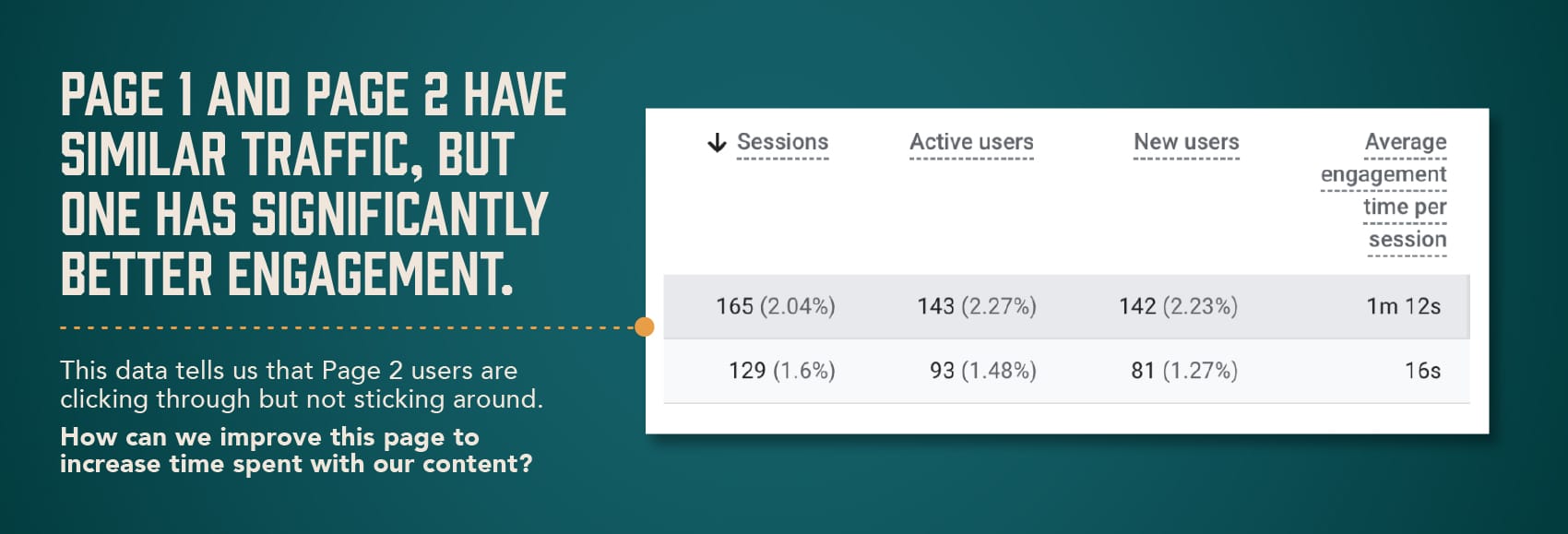
Rachael’s Tip: If people are clicking through but bailing, your headline did its job, but your content didn’t. They came for something that looked interesting and left because it didn’t deliver. So, what’s missing? Dig in. Maybe it’s clarity. Maybe it’s content that adds value. Maybe it needs more eye-catching assets—video, infographic, and charts. Tighten it up, make it useful, and give readers a reason to stay.
Stay tuned for more in-depth insight into how to create and optimize content that will actually help you achieve your business goals. Don’t have time to wait? Contact the experts at The Marketing Dept. to learn how they can support your SEO and content marketing goals.


