

If you’re posting content—on your blog, social media, or email—without a plan, you’re wasting precious time and resources. Creating content is about drawing potential customers into your world with helpful resources that build trust and loyalty; it’s not about making a bunch of quasi-relevant content to fill the space or hit a posting quota. Here’s how to build a content calendar that matters, a content calendar that converts.
Key Takeaways
- A content calendar only drives ROI when it is grounded in strategy. Every piece of content needs to tie back to a clear business goal.
- Start with a deep understanding of your audience. Build detailed personas based on real data so your content speaks directly to real pain points.
- Define specific, realistic goals and KPIs for each channel. Measure success differently across platforms (web, email, social) and benchmark against current performance.
- Focus on impactful content channels, not all of them. Use analytics to identify where your audience engages most, then prioritize those platforms.
- Conduct a content audit before creating new pieces. Identify high-performing content, optimize underperforming pages, and look for quick wins where traffic exists but engagement is low.
- Build content around 3–5 core pillars tied to your expertise and audience needs. Use these to create structured topic clusters that strengthen SEO, internal linking, and topical authority.
- Optimize for search intent, not just keywords. Align content to funnel stages (TOFU, MOFU, BOFU) to guide users from awareness to conversion with the right message at the right time.
- Prioritize quality over quantity. High-value, user-first content that demonstrates expertise (E.E.A.T.) and strong UX (SXO) will outperform high-volume, low-impact publishing.
- Structure content for both users and AI. Clear headers, key takeaways, internal linking, and strong on-page organization improve visibility in search engines and AI-generated results.
- Amplification is essential to ROI. Promote content through owned channels, paid media, partnerships, and repurposing strategies to extend reach and maximize your content.
- A content calendar should integrate with broader marketing efforts. Align with sales, campaigns, events, and cross-team initiatives.
- Continuously track performance, test approaches, and refine your strategy to improve results over time.
Table of Contents
- First Things First—Define Your Audience
- Establish Goals and KPIs
- Establish Content Channels
- Conduct a Content Audit
- Create Content Pillars
- Create Topic Clusters and Queries
- Strategize Search Intent
- Construct High-Quality Content
- Amplify Your Content
- Create Your Content Calendar
First Things First—Define Your Audience
Before you start creating, you’ll want to understand who you’re speaking to. What is it that your customer is looking for from your product or service? Keep in mind that most potential customers don’t know which products or services they are looking for, they just know they have a problem. By understanding your potential customers and, importantly, their pain points, you’ll be able to craft content and marketing messages that identify your brand as the solution your customer needs. You can define your ideal potential customers through personas. Consider personas your guardrails for all marketing activities. The more you are tapping into the real needs of your customers, the better your content will perform.
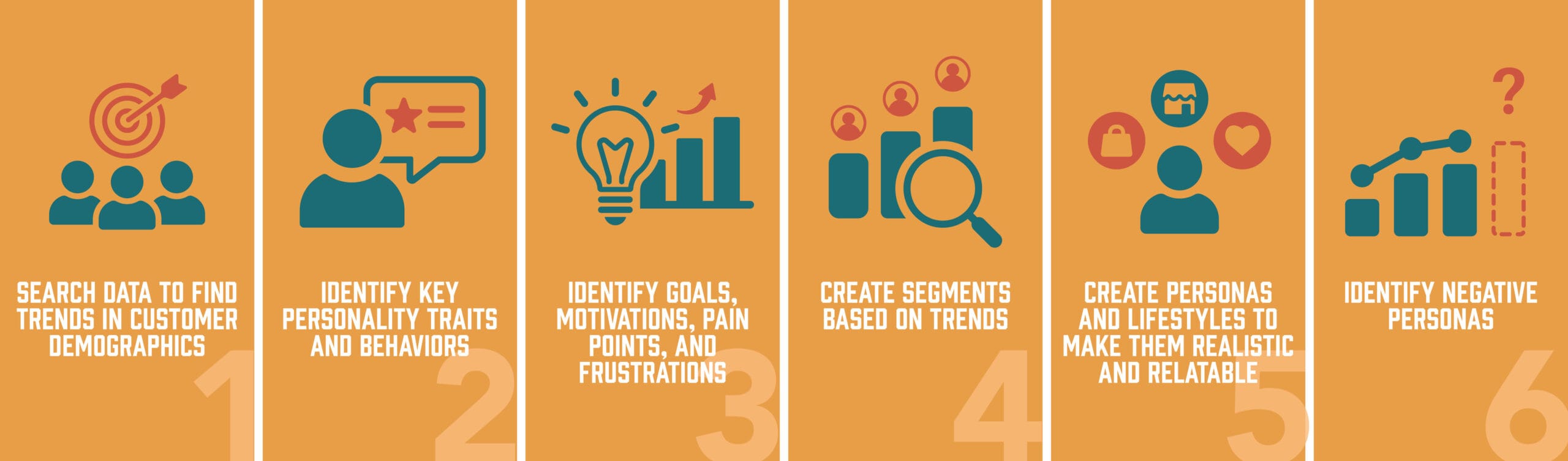
How to create a marketing persona
- Search website and sales data to find trends in customer demographics
- Identify key personality traits and behaviors
- Identify goals, motivations, pain points and frustrations
- Create segments based on trends
- Create personas, create names, caricatures, and lifestyles to make them realistic and relatable
- It’s also helpful to identify negative personas—define who you don’t want to target with your content. Negative personas might include someone who engages your sales people with a lot of questions and feigned interest, but will not in the end make the purchase. There is no point in draining resources—time, energy, and money for people who will never make the leap. By defining these groups, you can focus your efforts on the communities that will bring the greatest ROI.
How to set the foundation for great SEO
Establish Goals and KPIs
Creating content without setting clear, measurable goals is throwing money into the wind. As you begin to lay out your content, consider: How is your content going to help you achieve your business goals? Will it drive traffic to your website? Capture leads? Drive conversions? Build brand awareness? Educate customers about how to use your product? Offer solutions to problems your potential customers face? Highlight your industry expertise? There is no one correct answer to this question, but tracking performance is critical.
Goal & KPI Tracking
Front page results for search engines and AI overviews, and big traffic results are not achievements that can be accomplished overnight. We encourage clients to set realistic, attainable goals that build upon current performance. For example, if your site is receiving 100 visits per month from organic search right now and you set a goal to hit 3,000 visits per month in the next quarter, you are likely setting yourself up for failure. Setting smaller, achievable milestones on the path to a lofty goal allows you to refine your strategy to build real, sustainable growth.
We recommend creating unique goals and KPIs for each platform. A website, an Instagram ad, and an email campaign all do different jobs, so measuring them the same way gives you meaningless data. Website performance is measured by traffic, time on page, and conversions. Social platforms like Instagram or YouTube are measured by reach, engagement, and clicks. Email is measured by open rate, click-through, and unsubscribes. Before any campaign launches, we define what success looks like per channel, and measure it accordingly.
We use the following platforms to track performance metrics for our clients’ content:
Establish Content Channels
If you want your content to go the distance, you need to distribute content in the format your potential customers want to consume, in the networks where they want to consume it. Sometimes this means engaging in different channels to reach different customer demographics. However, it’s crucial that you don’t overextend your team by trying to post on every channel. So, how do you know where to post your content? Data. Cold, hard facts will help you determine which channels will deliver the most ROI.
You can find this data by reviewing web traffic, email campaign analytics, and social media insights. Which channels drive the most traffic? Engagement? Conversions?
By analyzing past performance, you can determine where people are engaging with your content most. We recommend starting with one or two high-impact platforms and focus your efforts on achieving growth in these areas. Focusing on the most impactful channels will enhance exposure and engagement, while protecting your resources. For maximum efficacy, you’ll want to coordinate efforts across selected platforms.
You’ll want to build quarterly reviews of platform-specific performance analytics into your content calendar to ensure these efforts continue driving results. A data-driven approach reduces guesswork and will help you make smarter, more targeted decisions about content creation and distribution.
Below is a list of potential channels to distribute your content, alongside suggestions for performance metrics. As you select your channels, consider how you will measure success. You’ll want to define performance metrics per channel that help you achieve your overarching performance goals. Don’t make goals that span platforms. Email, social, and paid ads all measure success differently and shouldn’t be compared against each other. Mixing channel metrics when measuring success will give you bad data and lead to bad decisions. Additionally, you’ll want to benchmark against your current performance. If your average blog post gets 197 page views, don’t set a goal of 1,000 next quarter. Allow yourself the time to scale gradually. Success builds over time, not overnight.
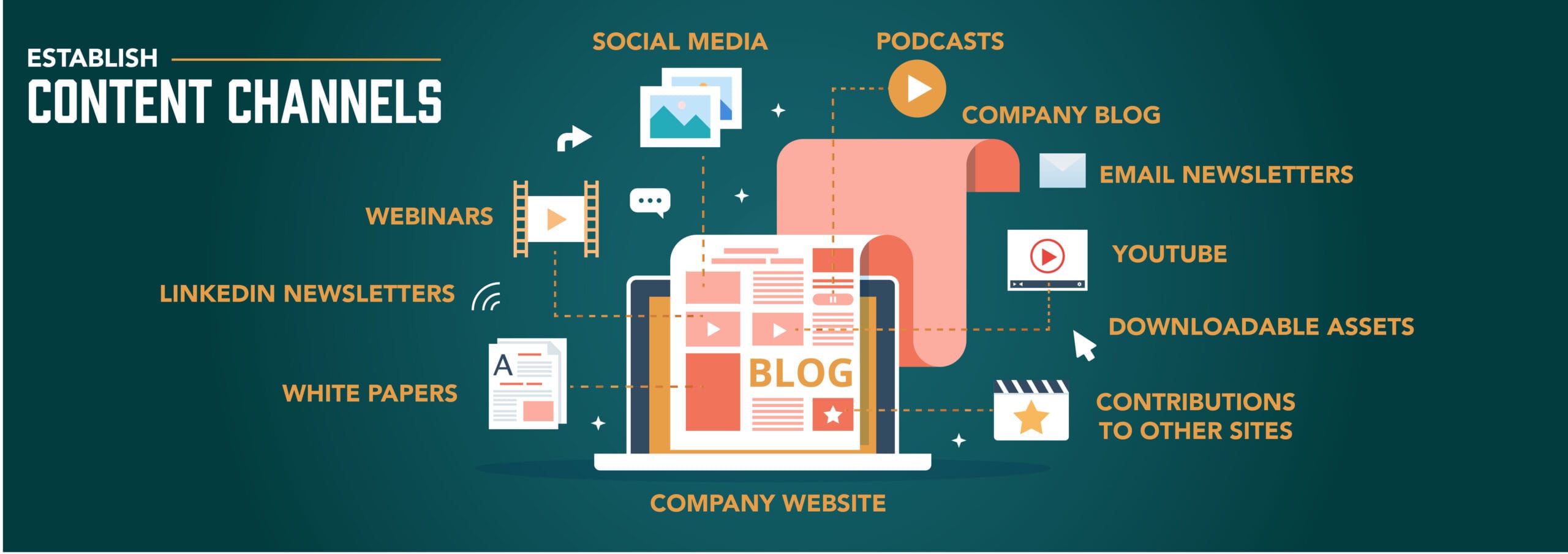
- Company website (traffic, time on page, bounce rate, conversion rate, pages per session).
- Company blog (pageviews, organic traffic, average time on page, scroll depth, newsletter sign-ups).
- Social media—Instagram, X, Threads, Facebook, LinkedIn, Pinterest, etc. (reach, impressions, engagement rate, clicks, follower growth, shares/saves).
- Contributions to other sites (referral traffic, backlinks earned, social shares, time on page, article reads).
- YouTube (views, watch time, average view duration, click-through rate, subscribers gained).
- LinkedIn newsletters (opens, open rate, subscribers, click-through rate, reactions/comments, follows driven).
- Email newsletters (open rate, click-through rate, unsubscribe rate, conversions, list growth).
- White papers (downloads, completion rate, lead conversions, time on page, form fills).
- Webinars (registrations, attendance rate, average watch time, engagement, leads generated).
- Downloadable assets (downloads, conversion rate, form submissions, leads generated, assisted conversions).
- Podcasts (downloads, listens, average listen duration, completion rate, subscriber growth).
Keep in mind that each platform has its preferred content format. For example, social posts require shorter, more conversational copy, blog posts perform well when they include in-depth expertise and high-quality references, and email newsletters require compelling subject lines and strong calls to action. Instead of thinking of customization as creating more work, see it as an opportunity to give your content more legs. We recommend starting with an in-depth blog post, and then breaking it into smaller, more digestible pieces that can be used across the rest of your channels.
Conduct a Content Audit
Before you create a new content calendar, you’ll want to take a look at what you’re already doing to determine what’s working and what’s not, and where you could make small adjustments to achieve bigger returns. Before mapping out the year or quarter ahead, take a critical eye to your content to see how you can provide more value to your target audience.
- In GA4, note the pages receiving organic traffic. Why do you think they are receiving better traffic? Which queries are bringing people to your page?
- What could you offer that would provide more value than your competitor’s content?
- How could you make this content more helpful?
- Review content for optimization opportunities—do your header tags need optimization? Does it have internal links? An author? What about high-quality external links?
- Would the content benefit from the addition of a video or an infographic?
- Does your content need an FAQ page?
- Is the content structured in a way that enables crawlers and AI overviews?
- Does the content include clear next steps for users who want more from your brand?
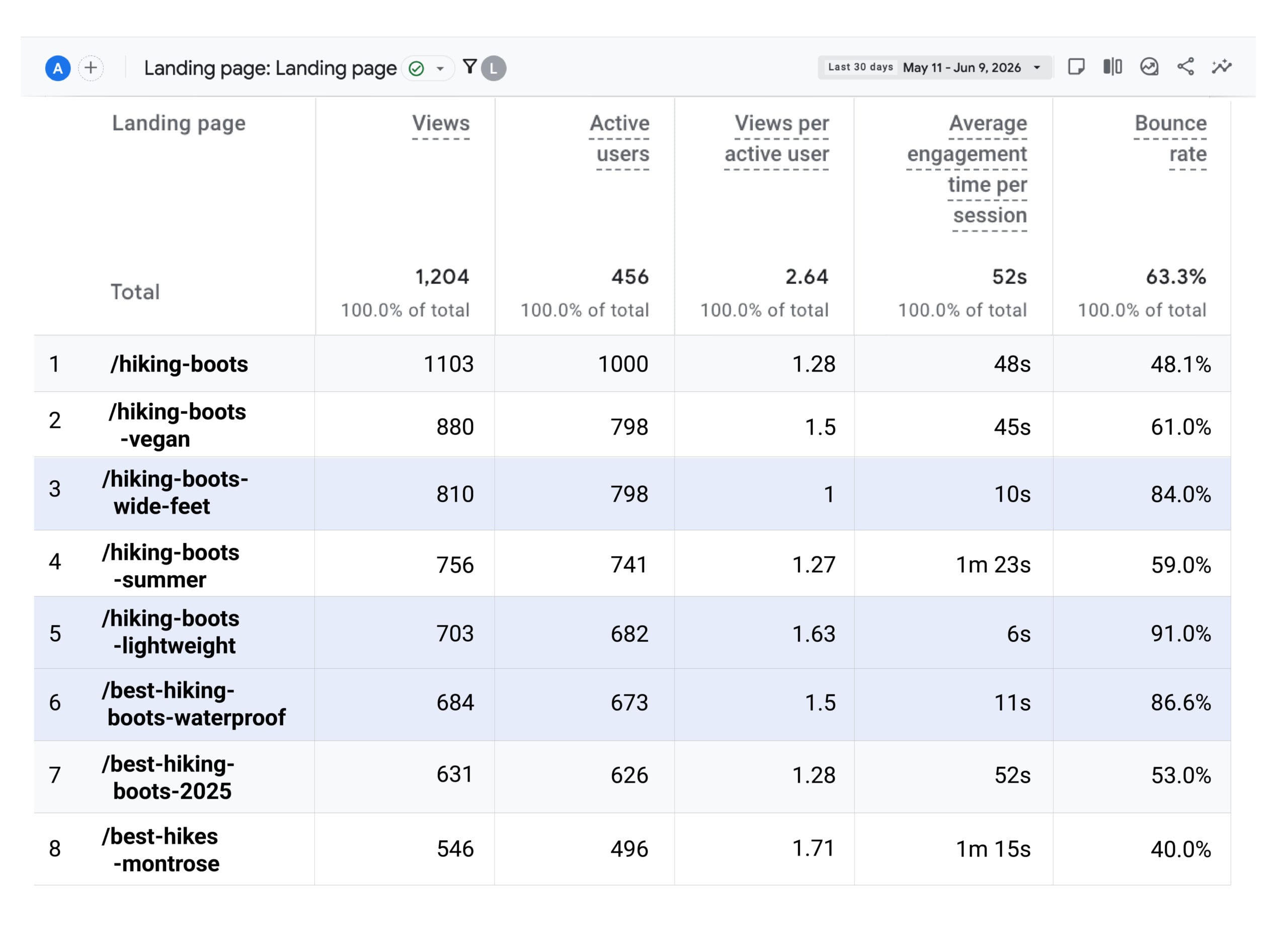
Rachael’s Pro Tip: Use GA4 to identify landing pages that have high page views but low engagement metrics (such as short time on page or high bounce rates). Start your content audit there. Ask yourself why visitors are clicking through but not sticking around. Sometimes, a misleading or unclear meta description might bring people in under false expectations. Alternatively, your title and meta description might be compelling—yet the on-page content falls short of delivering the promised value.
Evaluate these pages critically: Is the content addressing the audience’s needs clearly? Could it be more engaging or better structured? Are visuals, FAQs, or interactive elements missing? This targeted approach helps you fix the biggest gaps where potential interest already exists, often providing quick wins in engagement and conversions.
Create Content Pillars
Defining content pillars can help you keep your content on track by reinforcing key strategic messages, creating consistency and authority on decided topics, and focusing your internal resources.
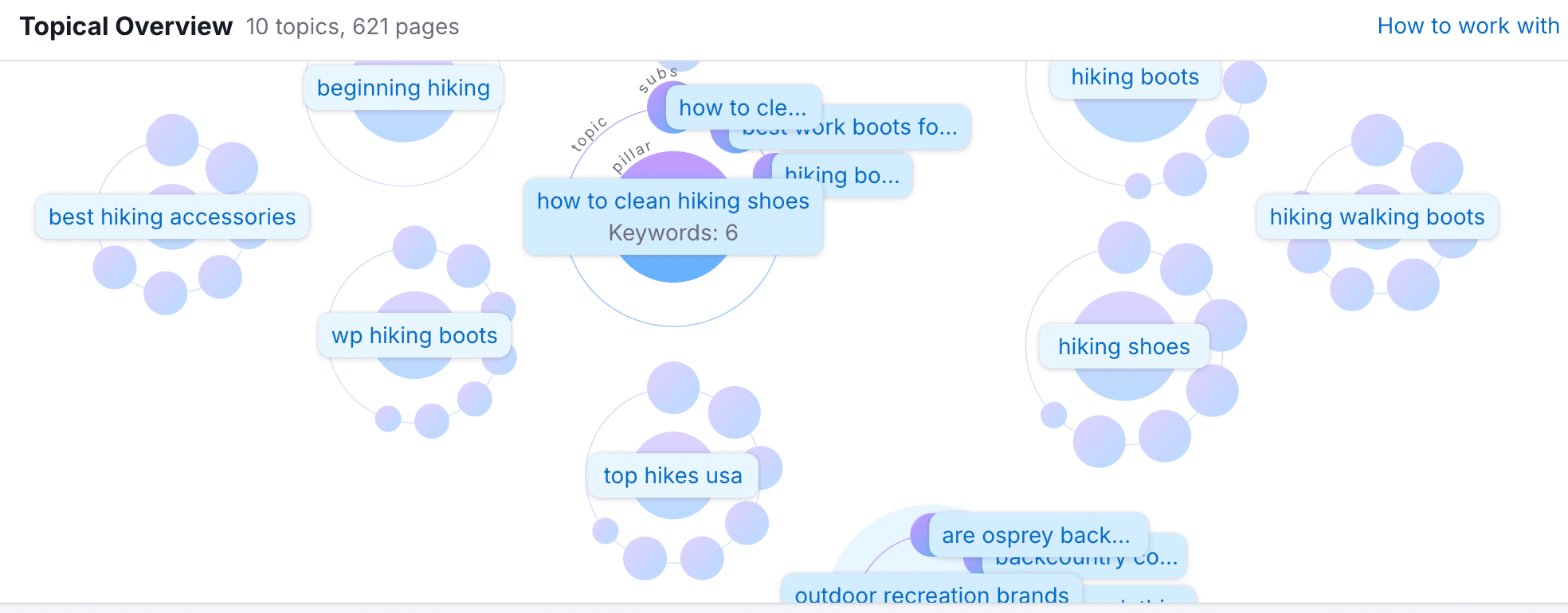
To get started with your pillars: Think of three to five topics that are relevant to your business objectives goals, whether they be brand awareness, lead generation, or customer education. To find these topics, you’ll want to tap into what your customers need, you can research customer feedback and questions, keywords, and industry trends to find out. Make sure that each pillar will offer enough depth to create multiple topic clusters. If you are a marketer for an electric cooperative, your pillars might be news & events, safety, energy efficiency, community involvement, and annual meeting updates. If you are a marketer for an outdoor brand, your pillars may be product/service questions, aspirational outdoor content, and expert features. When creating your pillars, make sure that you can go deep when devising subtopics (this will become important later). For instance, a pillar like energy efficiency could break down into clusters or queries such as home energy-saving tips, understanding energy audits, energy-efficient appliances, and does my co-op offer rebates. information.
When considering your content pillars, ask: Do these topics help us achieve our organizational goals? Do we have expert knowledge in these areas? Can we create helpful content about these topics? Remember to validate pillar topics against audience needs and competitor content gaps to ensure relevance and differentiation. From there, you can begin to build out clusters, topics and queries to fill your calendar.
Create Topic Clusters and Queries
Topics and queries are the new keywords. Instead of ranking for specific phrases, content is now ranked across search engines and AI overviews in terms of how well your content answers your users’ questions. Use your content pillars to create pillar pages that you can break down into in-depth topics. We also recommend diversifying content formats within the clusters to provide comprehensive answers to user queries—think breaking answers into video, blog, infographic, and FAQ content. Clustering your topics in this way improves SEO through internal linking that indicates depth of expertise that signals topical authority. Most importantly, though, well-organized topic clusters enhance the user experience.
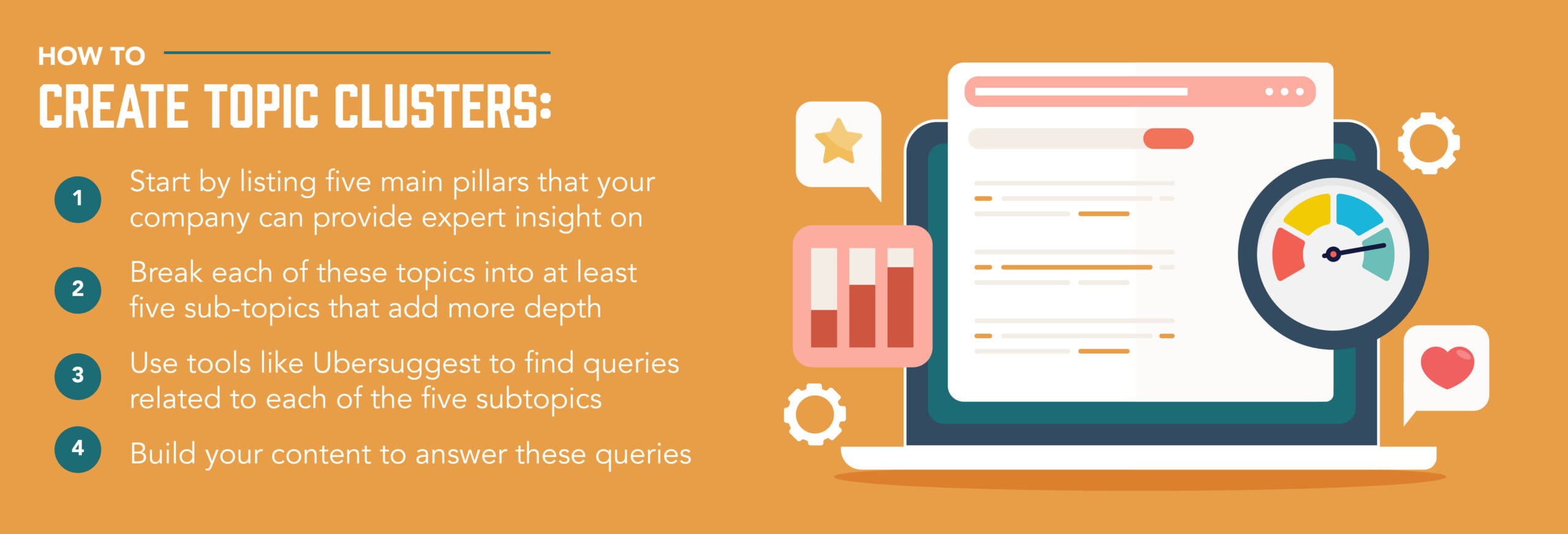
How to create topic clusters:
- Start by listing five main pillars that your company can provide expert insight on (these can become pillar pages)
- Break each of these topics into at least five sub-topics that add more depth to the main topic
- Use tools like Ubersuggest to find queries related to each of the five subtopics
- Build your content to answer these queries
Rachael’s tip: Topic clusters aren’t just a keyword exercise, they are best used as a strategic framework that drives meaningful, outcome-based content creation.
Note: Even though SEO and AIO optimization are evolving past the keyword, clear, descriptive header tags, title tags, and content hierarchy remain essential. A clean content structure allows for both an exceptional user experience and AI pickup.
Consider Search Intent
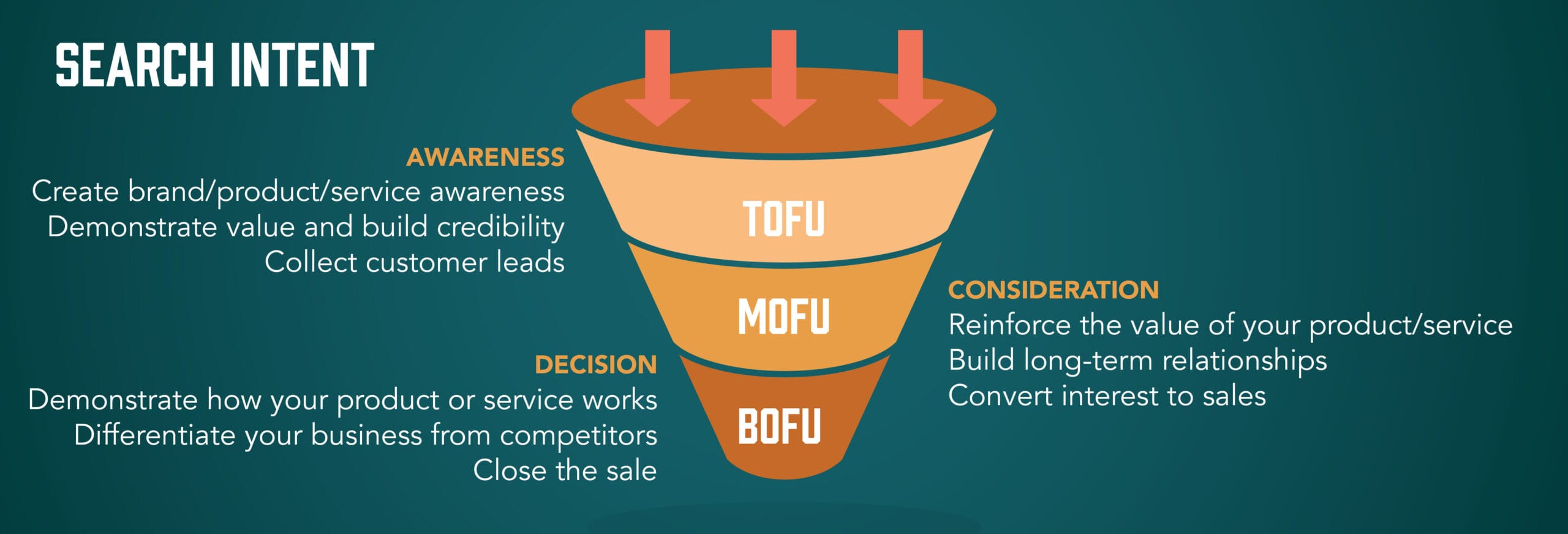
When creating content, you’ll want to keep your customers’ actions in mind—will this content help a potential customer discover your product or service? Or have they been interacting with your brand for a while, and they are ready to buy? Each piece of content can be created to meet a specific intended action.
TOFU: Awareness
Top-of-the-funnel (TOFU) content drives awareness about your service or product. It casts a wide net with the intention of filling the top of your sales funnel, knowing that only a fraction of these eyeballs will convert. TOFU content includes content like an outdoor gear brand’s blog post on “Best Hiking Boots for Hot Weather” or a dentist’s YouTube video on “How to Prevent Cavities and Tooth Decay at Home.” Using this content to capture an email lead can move potential customers further down the funnel.
The goals of TOFU are:
- Create brand/product/service awareness
- Demonstrate value and build credibility
- Collect customer leads
Examples of TOFU content include:
- Informational blog posts
- AIO mentions
- Social media
- eBooks
- Infographics
- Podcasts
MOFU: Consideration
As people begin to look to your brand for high-value content and expertise, they move to the Middle-of-the-funnel (MOFU). Content in this segment of the funnel is meant to transform leads into customers and shift their sentiment from consideration to decision. A med spa’s email campaign outlining various aesthetic plan options or a blog post comparing local broadband providers are examples of effective MOFU content.
The goals of MOFU are:
- Reinforce the value of your product/service
- Build long-term relationships
- Convert interest to sales
Examples of MOFU content include:
- Webinars with a lead capture function
- Email marketing
- Product and service comparison charts
- Interactive tools (like energy or cost-saving calculators)
BOFU: Decision
Once you’ve caught the eye of potential customers, and have started to build trust, they can move into the bottom of the funnel (BOFU). BOFU content is designed to convert. BOFU content is specific and persuasive. It explains why your product/service is the best choice on the market and includes clear calls to action that drive sales. Examples of BOFU content could include a promotional campaign spanning email, website, and social media, or a testimonial reel of happy customers/members.
The goals of BOFU are:
- Demonstrate how your product or service works
- Differentiate your business from competitors
- Close the sale
Examples of BOFU content include:
- Product demos or trial periods
- Case studies
- Testimonials
- Video walk-throughs
- Promo codes or special discounts
- Events or webinars
- Search engine remarketing
Construct High-Quality Content
Beyond making data-driven decisions, the most important factor in content marketing is creating high-quality content. Creating content that provides value, solves problems, and stands out from your competitors is key to attracting both users and AI-driven search rankings. It’s essential to build the proper time and resources into your content calendar, because quality is going to outshine quantity every time.
When creating content, pay careful attention to SXO—the combination of UX and SEO, a concept that prioritizes users having a smooth, engaging experience to support high rank on search engines.
Questions to ask about your content that can level up quality:
- Is your content helpful?
- Does it offer unique insights or original perspectives that directly address your audience’s specific needs and search intent?
- How does your content compare to your competitors?
- Are you using high-quality, optimized images?
- Do your title and header tags help users and web crawlers navigate your content?
- Does your content demonstrate E.E.A.T? (expertise, experience, authoritativeness, and trustworthiness)?
- Does your content include empathy, nuance, expert insight, and helpful information and tools? Is it human-first?
- Is your content answering the queries of your potential customers?
- Does your content contain engaging visual content that will keep eyeballs lingering for longer? Examples include compelling graphics, shareable infographics, tools like calculators, and videos
- Constantly ask, how can this content be better?
Can you use AI to generate your content? ChatGPT can spit out a blog post exponentially faster than a copywriter, but will it deliver the quality you need to drive traffic and conversions? Find out in Copywriter vs. AI
Is your content optimized to appear in AI overviews?
SEO is quickly evolving to include optimization for AI overviews and responses. In order to appear in AI searches, your content needs to be organized in a way LLMs understand.
Here are a few ways to optimize your content for AI overviews:
- Include key takeaways and a table of contents in your blog post to help AI crawlers pinpoint sections to feature in their snippets.
- Ensure headers are clear, searchable, and relevant to their section content to help crawlers understand what to pull.
- Create author pages that highlight expertise, experience, certifications, academic achievements etc. for your article authors to build trust signals.
- Include structured data in every page to tell AI crawler bots exactly what they’re looking at.
- Include brand signals to ensure your content is aligned with relevant topics.
- Engage in external PR outreach to enhance the authority of your insights.
Resource: Example of ideal on-page hierarchy for an AI-optimized blog post
Amplify Your Content
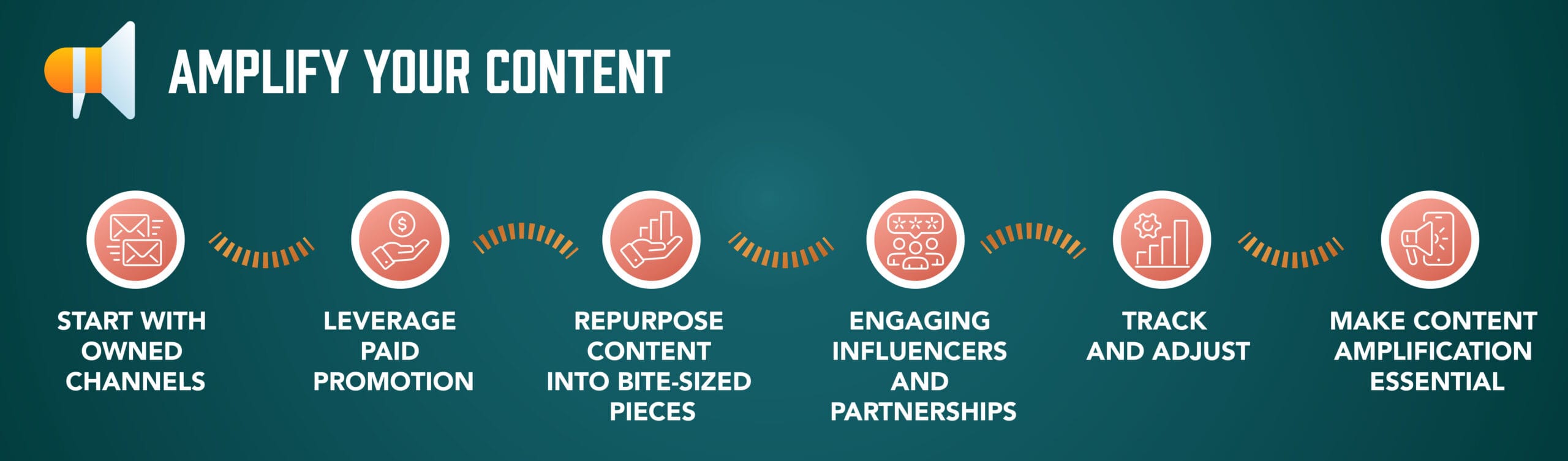
Creating great content is just the first step in using it to achieve your marketing objectives. Organic search results will only get you so far. A solid plan to promote your content will give your content legs, helping it reach more people, current users and new audiences alike. Amplifying your content effectively requires leveraging your strongest marketing channels to get it seen, engaged with, and shared.
Start with Owned Channels
First, use what you have to get the word out about your content—post it on your website, send a few email communications with compelling headlines and strong CTAs back to your content, and post across social media platforms to share it with people who already know and trust your brand.
For Faster Reach, Leverage Paid Promotion
If you want your content to reach new audiences quickly, consider paid advertising. When done right, boosted social posts, social media ads or Google Ads can significantly extend the reach of your content.
Need help with Paid Ads? Give us a call.
Repurpose Content into Bite-Sized Pieces
A single blog post or video can become many smaller, engaging pieces of content across channels. Maximize the value of every piece of content by breaking it down into smaller, engaging pieces to use across channels. With this strategy, an in-depth blog post can become dozens of social media posts, a few YouTube videos, an ad campaign, and a series of emails.
Engaging Influencers and Partnerships
Partnering with local influencers or community groups can get your content into new hands, with the added benefit of a credibility boost from someone they already trust. Reach out to influencers whose communities align with your personas. In many cases, you will need to pay for these partnerships, so make sure to build that into your budget.
Track and Adjust
Keep track of how your content is performing on various platforms—are you getting clicks back to your content? Which CTAs are performing best? Are you A/B testing your email subject lines for maximum engagement? Use data points from Google Analytics, social media, and email marketing tools to gauge which channels are most effective for amplifying your content.
Make Content Amplification Essential
Add content promotion to your content calendar to make sure it happens. Remember: the more you amplify, the more you ensure you get the best ROI for every piece of content your team creates.
Create Your Content Calendar
A solid content calendar not only keeps your marketing on track, helping teams across departments stay focused on creating content that achieves your business goals, it’s also an important tool for prioritizing work, forecasting resources, and measuring progress. Now that you’ve done the prep work to develop personas, pillars, and topic clusters, you’re ready to create your content calendar. Make sure you can back up every content choice with data, and that you have a solid answer to the question, will this help us achieve our goals?
Create your own content calendar in Google Sheets using our Download my content calendar template
- Is this content helping me achieve my business goals?
- Is the content calendar aligned with social, UX, and promotional calendars?
- Is your content aligned with UX to create effective SXO?
- What about planned website build-outs, email campaign schedules, and other social calendars?
- Are you breaking content into smaller pieces to share across platforms?
- Is your content calendar both consistent and manageable?
- Does your content calendar include search intent?
Rachael’s tip: Align your content calendar with other departments to maximize impact—how does your content calendar align with sales calendars, social media plans, promotions, special events, holiday calendars, etc. Coordinating efforts across all departments will make your content more impactful.
Practical ways to ensure intradepartmental collaboration include: setting up regular cross-team meetings, using shared calendars or project management tools that give all relevant team members visibility of every piece of the content distribution strategy, and clearly communicating deadlines and key dates. When there is cross-functional transparency in the content calendar, you reduce duplication, discover new opportunities, and ensure consistent messaging across channels.
Is your content giving you the most bang for your buck when it comes to SEO. Read our essential guide to SEO execution.
In the end, content marketing isn’t about volume, it’s about impact. For the best ROI, you want to focus on delivering consistent, valuable experiences across the right channels. A strategic content calendar is the roadmap that will help you get there.
Ready to level up your content? Download The Marketing Dept.’s free Google Sheets content calendar template to get started, or schedule a free discovery call to find out how to create a content calendar that drives real results.


